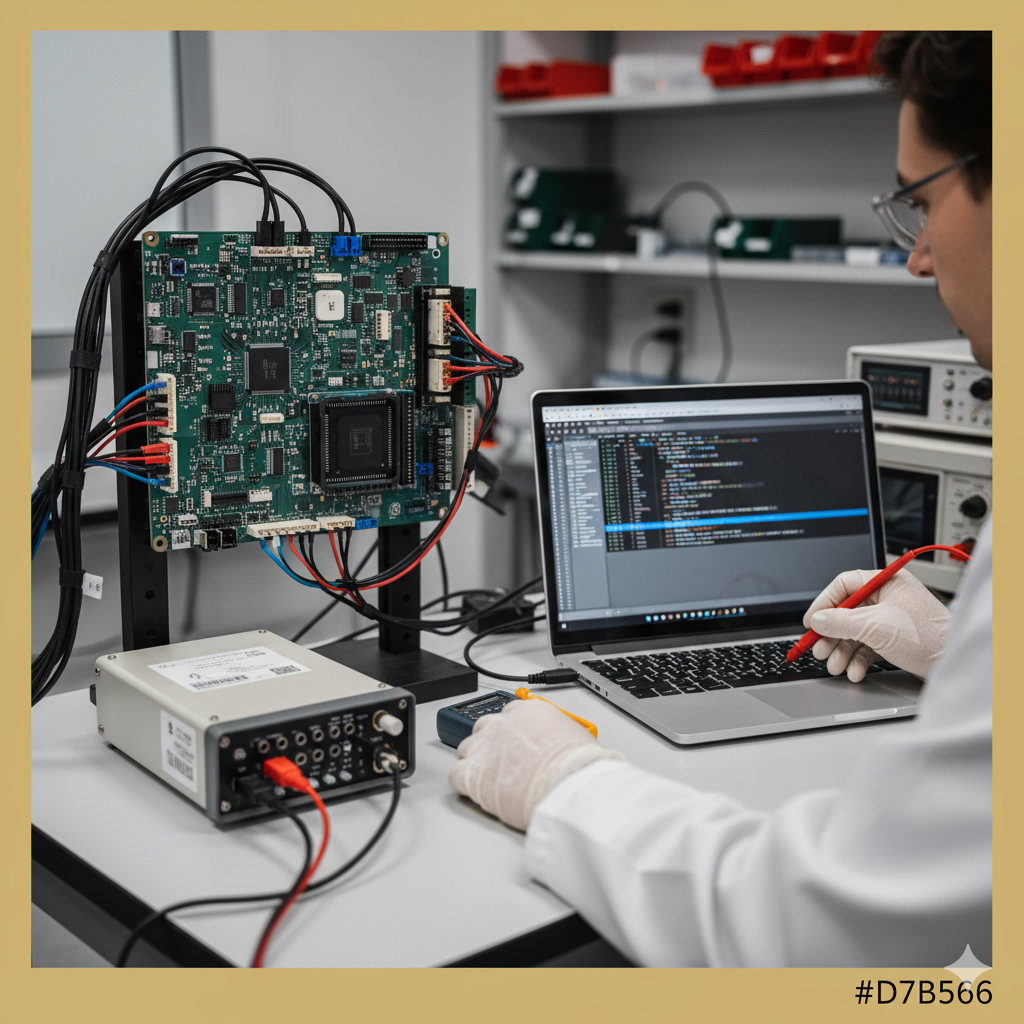
UDS stack Development
UDS Stack Development (Unified Diagnostic Services – ISO 14229) enables reliable and standardized communication between ECUs (Electronic Control Units) and diagnostic tools in modern vehicles.
Our custom-built UDS protocol stack supports services like ECU flashing, diagnostics, error handling, and security access over CAN, CAN-FD, LIN, or Ethernet.
Politics can be attributed to his perseverance to overcome his personal liabilities, and his desire to constantly become better. Next time you really want to achieve something, take time to focus on your own personal journal. What is your temptation that is standing in your wayv to greatness.
🚗 Introduction
In today’s connected automotive world, every ECU must communicate efficiently — not just for control but also for diagnostics, reprogramming, and testing.
That’s where UDS (Unified Diagnostic Services) comes in. Standardized under ISO 14229, UDS defines how diagnostic tools and ECUs exchange information.
Developing a robust UDS Stack is therefore a critical step for automotive OEMs and suppliers aiming to achieve reliable communication, efficient flashing, and fast diagnostics across their electronic systems.
⚙️ What Is UDS Stack Development?
UDS Stack Development involves creating the software layers that implement the Unified Diagnostic Services protocol on an ECU or diagnostic device.
The stack handles communication, data management, and diagnostic services as per ISO 14229 and integrates with underlying transport layers such as ISO-TP (ISO 15765) or DoIP (ISO 13400).
In simple terms, it’s the “brain” that enables your ECU to talk to diagnostic tools like OBD testers, CAN analyzers, or flashing utilities.
🧠 Core Components of a UDS Stack
Application Layer (ISO 14229-1) – Implements diagnostic services such as:
Diagnostic Session Control (0x10)
ECU Reset (0x11)
Security Access (0x27)
Read/Write Data by Identifier (0x22 / 0x2E)
Routine Control (0x31)
Request Download / Upload (0x34 / 0x35)
Clear DTCs (0x14), Read DTCs (0x19)
Transport Layer (ISO-TP or DoIP) – Handles message segmentation, timing, and flow control.
Network Layer (CAN, CAN-FD, LIN, or Ethernet) – Provides physical communication.
Hardware Abstraction Layer (HAL) – Interfaces directly with ECU hardware drivers.
🧩 Features of Our UDS Stack Development
Fully ISO 14229 compliant implementation
Supports CAN, CAN-FD, LIN, and Ethernet (DoIP)
Modular, scalable architecture — easy to integrate with existing ECU software
Diagnostic and Flashing Support (UDS services 0x34, 0x36, 0x37)
Customizable Security Access Algorithms (Seed/Key)
Optimized for real-time and memory-constrained ECUs
Multi-session handling for programming, extended, and default sessions
Integrated timeout, retry, and error management
Cross-platform support: AUTOSAR and non-AUTOSAR systems
🔌 Benefits of Implementing a Custom UDS Stack
Faster ECU Communication – Optimized message handling and lower latency.
Improved Diagnostic Accuracy – Supports all standard UDS services with robust error management.
Easy Flashing & Calibration – Enables secure and reliable firmware updates via UDS.
Seamless Integration – Works with existing CAN stacks, bootloaders, and HIL systems.
ISO Compliance & Reusability – Designed for reusability across multiple ECUs and projects.
Customizable Security Access – Protects your ECU from unauthorized programming.
🧰 Development Process
Requirement Analysis – Define target ECU, protocol type (CAN / DoIP), and memory constraints.
Stack Design – Create modular layers (Application, Transport, Network).
Implementation – Code development in C/C++ for embedded targets.
Integration – Interface with existing RTOS, communication stack, and bootloader.
Testing & Validation – Verify via UDS Tester, HIL setup, and compliance testing.
Optimization & Release – Final integration with production ECU firmware.
🔍 Use Cases
ECU Flashing & Reprogramming Tools
In-Vehicle Diagnostics & Fault Detection
HIL (Hardware-in-the-Loop) Testing Systems
Bootloader Communication
Automotive ECU Software Development & Validation
🏁 Conclusion
A reliable UDS stack is the foundation of every smart ECU system — enabling flashing, diagnostics, and secure communication throughout the vehicle lifecycle.
Our UDS Stack Development Services deliver optimized, production-grade implementations tailored for OEMs, Tier-1s, and embedded developers, ensuring compliance with automotive standards and seamless integration into your ECU architecture.
Whether you’re building a new ECU or upgrading an existing one, a robust UDS stack will ensure speed, reliability, and future-ready communication.
- Use a past defeat as a motivator. Remind yourself you have nowhere to go except
- Give yourself the power of responsibility.
- Remind yourself the only thing stopping you is yourself.
- Make a list of your achievements toward your long-term
- Goal and remind yourself that intentions don’t count, only action’s.
If you were choose the path to the right, the right path, there are new possibilities, achievement, freedom of mind, positive and progressive implications. Think about that as you stand at this place where the path splits. You want to make a decision and commit to one of these paths. Before you make that decision, we are going to see what each path holds for your future.